Dubki
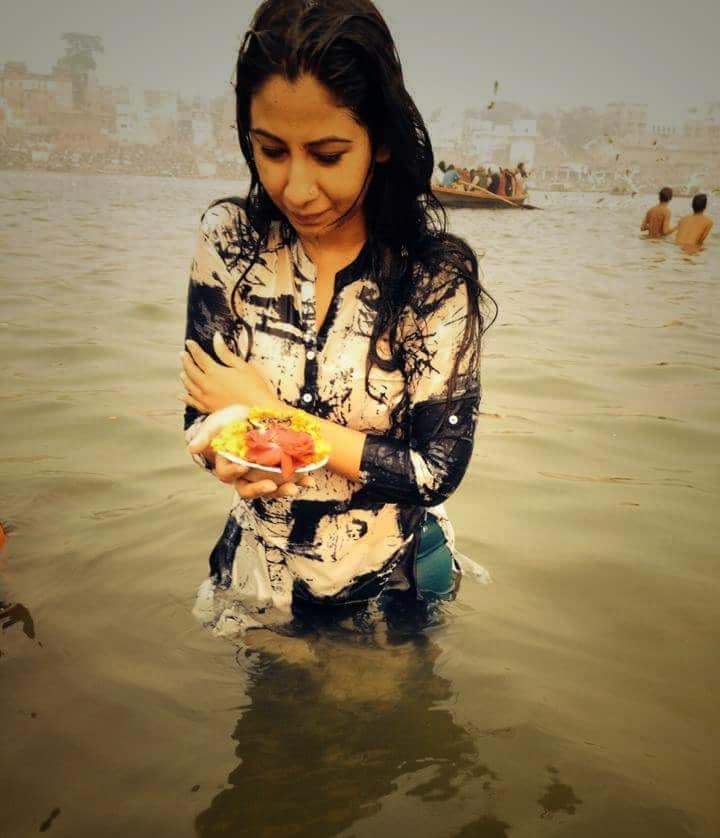
The first time I took an unholy dip in the Ganges, on a chattering cold morning in Varanasi – I was distracted.
Not by the milieu of half naked men and their belching middle age, or the debris that Ganga witnessed every morning in the name of staunch religion- but by this feisty woman, long braided hair that fell to her waist, doing the backstroke, so effortlessly, with mermaid like fins, in a salwar kameez.
“Dubki lo… Arre le lo. Kuch nahi hoga” – she yelled at me, smiling, mischievously chiding, “darte kyon ho?”
I took a quasi-dubki and ambushed her, “where did you learn to swim like that?”
“Khud seekhi.”
I told her she was beautiful, so beautiful, so khoobsurat!
And I told her the women of Varanasi were something else, and I pointed to everything I was standing in the midst of – shrads, funerals, far away pyres still aflame, little flower baskets of mannat and duas, leaves, torn garlands, human vulnerabilities, human foibles, telling and tugging, hurriedness in muhurats and horoscope abiding schedules – and there she was, gliding like a mermaid, tilting her face to the sun, her white skin turning pink.
I waved to her as I left, as she would go home, unremembering me, and I would go to back to my bustling city, reminiscing her bravado.
One of the reasons I didn’t learn swimming when I was in my teens or later- the liminal young, was because I didn’t want to learn swimming in a salwar kameez. Given the traditional mores of the 90s Chennai, with the youngness of an Alaipayuthey, and Madhavan bursting into the seams of our consciousness, our dupattas were unfurled on his face with unhinged delirium as he rode the bike, whistling to “Endrendrum Punnagai…”.
Devi – one of the oldest blockbuster screening theatres of Chennai saw all the salwar kameezes that were EVER to be seen from the city, its screens spilled forth with yellows and blues and oranges, all the imaginable discordants on our whispering brown skins!
We were shy.
We looked down more times than we looked up.
We pinned our dupattas.
Secured them, taped them, flattened them down – with safety pins.
The salwar kameez is all that we ever wore.
We called it chudidhar.
We didn’t buy those sets that didn’t come with a dupatta.
We were pulled up in class if we dared sling it effervescently on one side and let it flow like Madhuri Dixit did in Dil toh pagal hai.
We watched Aishwarya Rai in Hum dil de chuke sanam, and gasped – collectively, as she emerged from one billowing dupatta to another. “How beautiful she was!”
As we marveled at her litheness, we watched in awe as she ran the streets without a care, walking – not with a demure elegance like we were coerced to, but a dominant, boisterous stride that demanded she be given the right of way.
We thought,
A – it was pure cinematic license, which woman could ever walk the middle of the street?
B – if at all that was ever possible, maybe you had to come with that sort of devastating beauty.
And we didn’t learn to swim.
On that day, in the Ganges – after the many moons of survival and hankering back to the old, the nostalgic and the unlived, I remembered Rai and litheness- and pondered over the geography with its rivers and rivulets, its social mores and its inevitable shackles – that gave a woman her latitude – in what she wore, to how she swam the lakes.
That very evening I would marvel at a young girl, barely twenty, that snarled and spat on a young boy, that might have accidentally or un-accidentally brushed against her – she hollered after him, “dikta nahi hai kya???”. I asked her too, “How are women in this city so brave?”
I was in a saree and she was in her jeans, and a casual T-shirt, forehead smeared with slight, almost imperceptible ash.
“You do what you have to do.”, she shrugs her shoulders, visibly embarrassed at having been lauded for what – for her, was a strike in the realm of the ordinary, but for me – fierce and scintillating.
I took back the Varanasi woman with me.
And then I heard of the Kanpur woman, that strode the gritty streets with a slit skirt, hair tossed up in curls, for a Valentine’s Day in the 90s.
These are the women.
Barefoot, blistered or stilettos.
That grab the social strictures, the warts, the moles, and all other deafening ugly – by their heels, turn them upside down and rattle the change out of those bulging pockets.
As the woman from Bihar tells me that she too learnt to swim in a salwar kameez, in some forgotten rivulet of India’s treacherous landscape, a small town, an obliterated memory, a receding ravine – and then one day, went on to swim the vast expanse of the turquoise of the vivacious Amazon…
- I think of all of us.
That were told to look down and walk.
That one day, as the sun tilted a little more in our wake – found our defiance!
Who thought, for a moment, ever so slight and subtle – before we took the Dubki.