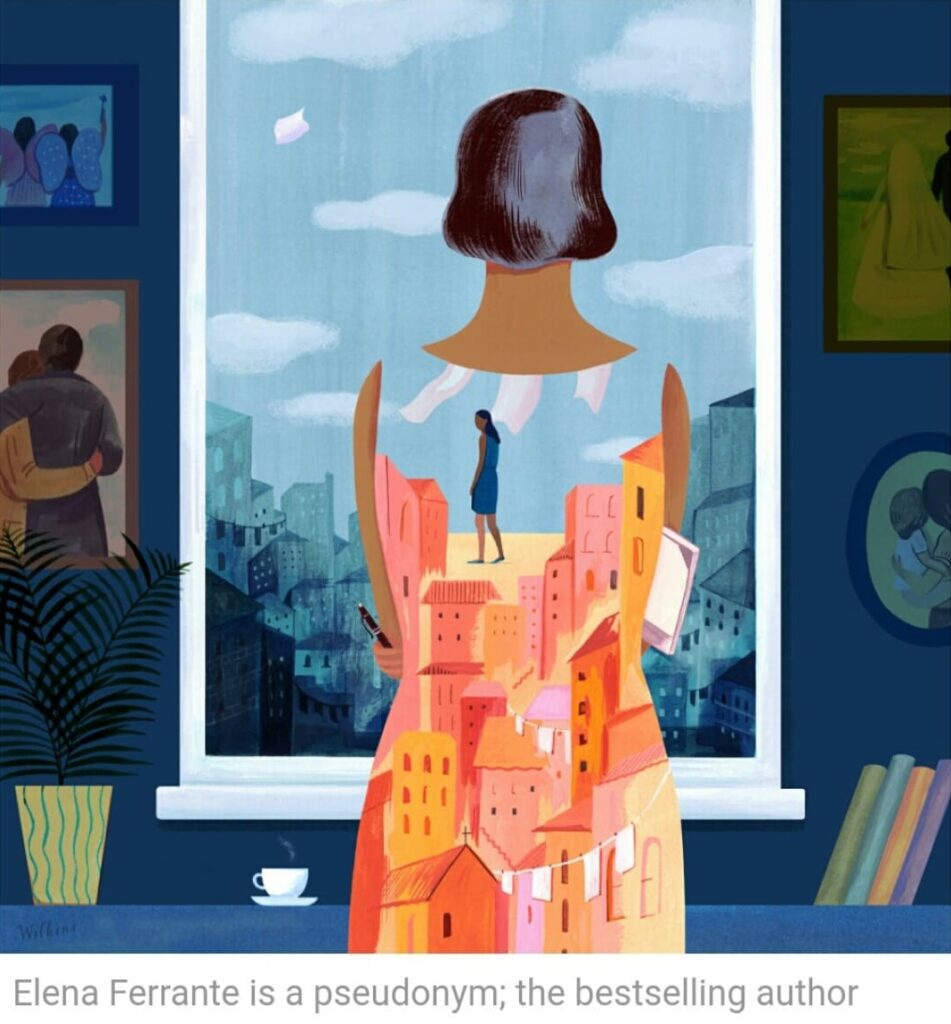
Elena Ferrante
People on a reader’s block, people trying to read a lot, this is a great place to start and hone your speed. Here’s a review that I wrote for a reading group.
Okay so 1696 pages of Naples is in my head and I can’t shake it off! 4 books of the indomitable Elena Ferrante’s Neapolitan series – devoured amidst nights that stretched into dawn, sultry afternoons that went sans food and Netflix, and phonecalls that went answered. I am trying to look for adjectives- and none of them seem to fit, none of them seem to suffice, embroider even – compelling seems too frivolous, piercing seems singular and incredible seems way too general. There’s a hypnotic force in her writing – the whole story, starts and ends in a neighborhood with 6 families, some of them drenched in poverty, all of them enormously sinful, most of them treacherously suspicious of one another and all of them, equally and relentlessly gasping for air, fighting for redemption, and escape – from the squalid undercurrents of the neighborhood.
The Children go to elementary school – Lila is the most brilliant of all. Her friend, Elena or Lenù, is equally brilliant but we know not, in the first few pages. We wonder what these 8 year Olds are going to pull off – in this tome that lasts a 1700 pages, we think they are going to leave Naples, move countries, have many loves, live many arbitrary lives, making an ocean of friends that they share and unshare, make kids, be loving mothers, perhaps? Or fight to love their kids the most? Perhaps? – but Ferrante has other plans.
She keeps the girls confined and entrenched in the neighborhood – she has them embroiled, in the innocuous larceny to the larger treason, in the trifle skirmishes to the bigger confinements, in deceit, in venomous revenge, in retribution – both mortal and emotional, in a myriad things that life usually twists and turns around – arising out of the most normal of circumstances.
There’s Enzo, the fruit seller’s son, there’s the Solara boys driving around the only Fiat of the neighbourhood, there’s Pasquale whose father is a Communist and is serving term, there’s Antonio – the mad widow’s son, there’s Stefano and Alfonso, Don Achille, the loan Shark’s sons, and then there’s Nino Sarratore – the hero? Nino Sarratore occupies the pages – because he dives in and out of the girls’ lives, he captures their imagination, they are caught in his throes, and as you read him, you know that you ‘know’ this boy/man. That you have fallen for precisely this type of boy/man, at some point in your life – enamored by his dazzling husk, the dazzling husk that is peremptory and fleeting, you never really get close enough to crack open its layer and peer inside, there’s so much you don’t know, yet, you’re so insistent about his inherent, unseen principles and virtues, you’re always afraid of losing him, and his many truths slip under your memory – with his identity, constantly slippery and mutable.
Lila squanders her brilliance, but Lenù holds on, she studies and studies. Makes it from elementary to middle to even high school, and fights and digs her claws in to secure a place at a university in Pisa. Yet, she’s always hovering around self doubt, unable to disenfranchise, to disentangle from her brilliant friend – Lila, constantly seeking validation, constantly examining her self worth, constantly berating herself about the pointlessness of it all. This too – you know, you recognize, because you have that one friend, who you constantly admired, but were also equally wary of, you couldn’t ever figure out what she was thinking, you didn’t ever know what she truly thought of you – you both had an immense, shafted childhood, neighbourhoods that you walked, boys that you simultaneously crushed over, but do all those tiny things, in which the good sun and squealing together in a sea, hold up against the shuddering temerity of life? Did those fragile pieces of childhood add up at all to a sisterhood? Or did they simply subtract the inner idiosyncrasies that were never harmonious with your ambition and your becoming?
And in this sense, is Ferrante’s Neapolitan series so violently personal, so dammingly evidenced, of all the things that break us and then reconstitute us.
Read at your own risk, because you will completely surrender, you’ll be thrown asunder, you’ll smell the neighbourhood – the book is so olfactory in its breath, you will be so ripped apart by its people and you will. Not. Sleep.