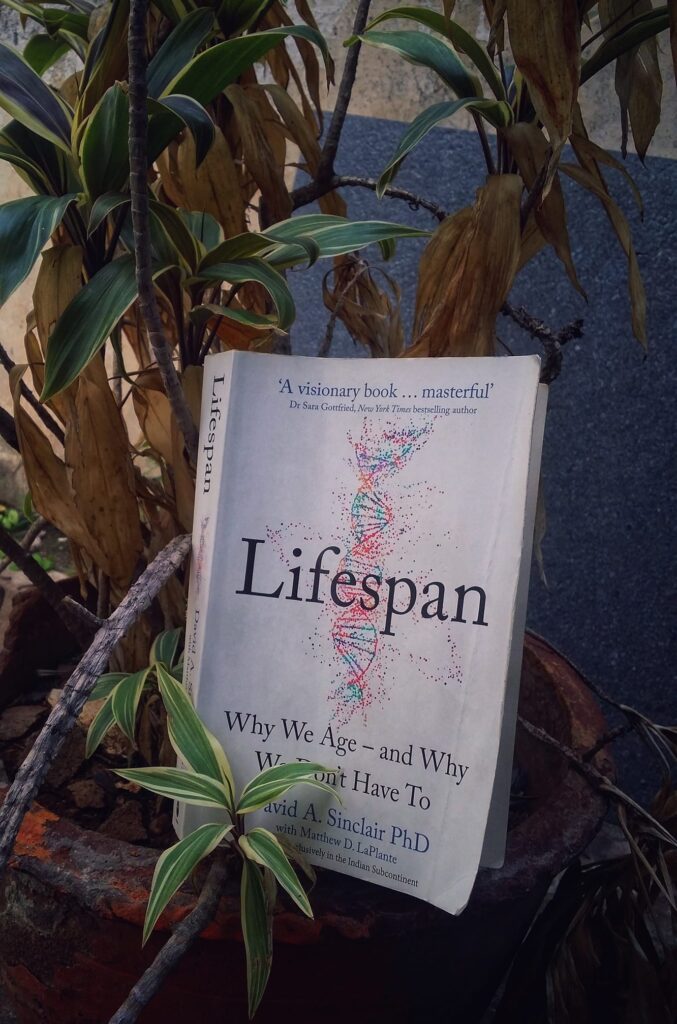
Lifespan
50 is the new 30! – we tell our friends when their wives/ husbands throw them a grand surprise party, we make lame jokes, we suspend retirement plans, we tease them about when the next date is, we tell them the salt and pepper looks sexy and how they don’t look a day over 30 – “just more gorgeous.”
And to this, Dr.Sinclair says, “How blithely… how blithely we say 40 is the new 20 and 50 is the new 30?” – considering only 74,000 years ago, our species was driven to near extinction. By 1930, (after the slew of deaths due to the Spanish Flu of 1918), thanks to sanitation and decreases in child-mother mortality – our species grew at 1% per year. And by 1970, thanks to immunization and improvements in food production globally, the rate became 2% a year.
And today, we are seven billion – and baby showers are officially a movie-making business, with thousands of freelance photographers hired and paid handsomely to shoot bellies of all types, in billowing swaths of several yards of shimmery fabric.
Unless we get hit by a bus, most of us can work ourselves up to a good lifespan. Alexa and Siri and our smart watches monitor our steps, our heartbeats and our blood sugar- and more bio indicators are only a click away. And there is research underway, expansively – for every degenerative disease such as a Cancer or Alzheimers or Parkinsons. And of course we learnt, in the great 2020 – that we have to be potentially warned of the virus, in all of its splendid manifestations – the door knob guys.
But what if we had more time? What if we could live to a 120 and start our second careers as Farmers and Teachers and even Movie Actors at 65 plus? And what if women had more time? Much more time? And they didn’t have to put their careers on hold or an abrupt stop, to go raise kids?
What would humans do – the incredible humans, with more time? On their capable hands.
This is what the book chooses to explore, switching between hardcore science and the humanity of things. And Dr. Sinclair is a marvellous story teller – the story of our gene and epigenome, and what we can to reverse aging and the thrilling possibility of OTC capsules that one can pop in after breakfast, for healthier and longer lifespan.
In 1970, two psychologists decided to put the Parable of the Good Samaritan to test. The parable revolves around who stopped to help a person in distress. So they hired an Actor to double over in pain, along the corridor. And they recruited 40 seminary students for a lecture at the Princeton Theological Seminary, at the Green Hall Annex, next to which the Actor was to double over, coughing. The students were divided into 3 groups – one, asked to get to a point B quickly, the second, to take their time but not too much and the third, to take their own sweet time. The ones that were asked to rush, didn’t stop to help. They hurtled themselves along the corridor. But the ones that had more time, stopped by and helped.
Humans are a lot more humane, when they’ve got more time. And this, I’ve seen so much with Travelers – at the hostels, everyone is sitting together sharing tips about the cheapest way to get to a place and the cheapest place to eat, women warn other generously about how to take of the hair in the wild, people with conflicting afflictions team up and embark on a journey, and you see much less selfishness, way less hoarding.
Dr. Sinclair explains the science of it – with clarifying language and syntax. Our cells divide enormously, and with every cell division there is a DNA breakage, the Avenger type proteins called SIRTUINs (especially SIRT3 and SIRT7) sitting on the mating gene, is recruited to help with this repair. Ideally, the sirtuins go fix the DNA repair and come back to the mating gene, but if there is too much DNA repair and too much Chaos, they are unable to come back to the mating gene, causing the mating gene to turn on and confuse cell identity (epigenetic noise), thereby leading to infertility and finally senescence. So for us to age slowly, the DNA repairs need to occur in ‘limiting formats’. Using an analogy Dr.Sinclair explains –
//I’ve come to think of sirtuins as the Directors of a multifaceted disease response corps, sending out a variety of specialized emergency teams to address DNA stability, DNA repair, cell survivability, metabolism and cell-to-cell communication. In a way, this is like the command center for the thousands of utility workers from Mississippi who descended upon Louisana in the wake of Hurricane Katrina in 2005. Most of the workers weren’t from the Gulf Coast, but they came, did their level best to fix what was broken and went home. When they’re home these folks take care of the typical business of being at home : paying bills, mowing lawns, whatever. But what happens when there’s one emergency after another? Hurricane after hurricane? The repair crew is away from home a lot. The bills become due, then overdue, and the grass grows too long and soon the President of the Neighbourhood Association is sending nastygrams.//
The incredible research that is going on passionately and stealthily in the Science Labs of Harvard and others, is to figure out ways to inject a couple of extra Sirtuins (Avengers) and reduce epigenetic noise, while the Avengers are at battle. Meanwhile the book is abundant with simple tips that are easy to undertake, that can easily give us a couple of years or more of good health – like exercise (of course!), bushwalking, resveratrol (red wine, that’s great news indeed), metformin and foods that enhance mitochrondria, TOR inhibitors, AMPK Activators etc.
The book is also replete with anecdotes and scientific and socioeconomic pursuits of the incredible Human Species, despite all of its frailty and finitude, to usher us into an era of lesser and lesser diseases and more and more cures. A team of unsuspecting Biologists on an expedition to Rapa Nui, a remote volcanic island 2300 miles west of Chile, would go on to discover ‘S.Hygroscopicus’ that would lead to the birth of the drug, Rapamycin – that inaugurated a new era for patients that needed an organ transplant, because rapamycin lowered the immune response in the host body, so that the donor organ could be accepted.
And finally Teeth! Who wouldn’t like to have great teeth, until the day we died?
Dr. Sinclair talks about how our medical system is principally organized under ageism. The Dentist boring into Dr. Sinclair’s 50 year old jaw had pronounced, “Your teeth are fine. Just the normal wear and tear. Your front two teeth are worn down and if you were a teenager we’d have them fixed but-”.
“I’d like to have them fixed please”, he asserts.
//when we are young we don’t get treatments that could keep us healthy as we grow old. When we are old, we don’t get the treatments that are routinely used on the young.//
On June 2018, WHO published an International Code of Diseases (ICD-11), which is a fairly unremarkable report except someone slipped in a new disease code – ‘MG2A Old Age’ – which goes by the definition of
· Old age without mention of psychosis
· Senescence without mention of psychosis
· Senile debility
Of course, I would want to live to a 120 and want all of my family and friends to live to a 120 and thereby give ourselves plenty of extra time to read more books, smell the roses like Seneca says, and have our parents around when our friends throw us a surprise 60th party – but what would we do, with a 120-150 on our politicians? On our rogue and diabolical law makers?
Because where there is Science – there is also plenty of stupidity, that is usually heavily funded too.
A single F-22 Raptor fighter jet is upwards 335 million dollars.
Fighting this Research against aging, a 2003 report filed to the White House by the President’s Council speculated –‘Would people be more or less inclined to swear lifelong fidelity ‘until death do us apart’, if their life expectancy at the time of marriage were eighty or a hundred more years, rather than, as today, fifty?’
And of course, we might never get the Science we deserve.
The Poor, much lesser.
And how do I rate this book? An absolute delight!
Lifespan
By David Sinclair