Quichotte – Book Review
WHAT. DID. I. JUST. READ.
This felt like a ‘Master and Margarita’ set in the socio-political maelstrom of an Era that’s hurtling towards its rhythmic 2020. Only, you knew the fine curve lines of the Russian classic, it was a story within a story, but you knew the veins and the ventricles of the plot – all swerving deftly towards the deeper denouement of the climax. It had a flying pig, a talking Cat, and the Devil dressed in a tuxedo – but you still got your brain to do the talking.
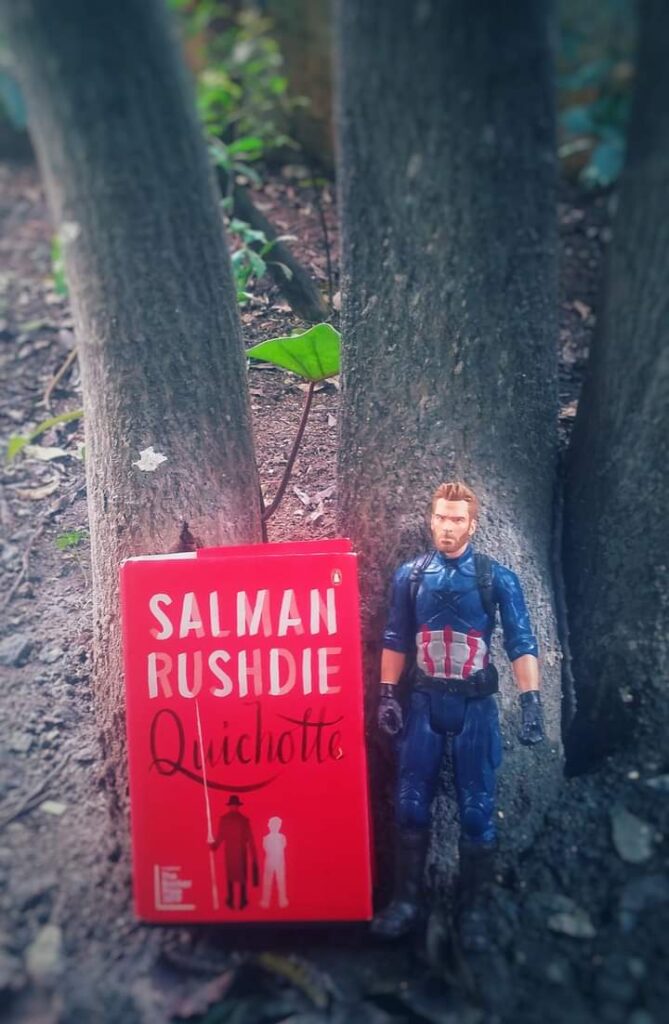
Rushdie’s latest offering is you sitting atop a time capsule, dressed for the Victorian dinner, when your next unforeseeable destination is the Azure window, of Malta; or you naked, thrown into the mayhem of kanjeevarams in a south Indian wedding. It’s that’s bewildering, meandering, and non-conjoining with the real and the factful.
IL nome è Quichotte (that my phone dutifully autocorrected to Quixote). Not Kwichoate, but Key-SHOT. The author magnanimously clarifies on Page Zero. He wants you to learn the name properly before you get intimate with Quichotte. Rushdie says that Cervantes himself would have called this guy ‘key-SHO-tay’ in the Spanish of his time, but for this story, he wants us to call him key-SHOT. At this point, I remember the original Quixote, astride a stallion, perched magnificently, in the Centre of Madrid – whom I had gone to pay my respects to, in the year 2016, not knowing back then, of course, that this magnificent ride, astride this stallion of work from Rushdie, would find me in a time, even more inchoate, even more, strewn asunder.
Quichotte is a salesman, from Bombay of India, (a time when Breach Candy was still new, where the apartments facing Juhu Beach hadn’t yet reached extortionate prices, so the old Bombay, still smelling of Parsi cafés, the low hum of ceiling fans, neither of them moribund), a travelling Salesman, a very old man, living now in Trump’s America, seeking asylum in the grubby motels of America’s famous squalor depicted in the movies, in the glowing company of his TV friends, the soap opera stars – but the crucial and the peripherals. Quichotte spends days together, holed up in a motel, watching reality shows, the dawn and dusk of the outside surreptitiously played out in a loop, never looming over his TV existence. He falls hopelessly in love with Salma R. Another kindred soul from the old world Bombay, that found her fame in the bounty of America’s reality TV. Salma doesn’t escape her dynastic biochemistry, succumbing to the prowling grip of Fentanyl, a drug used to help with the breakthrough pain of cancer fighters. Quichotte resolves to go meet her, profess his love, write her letters of love, formulate his plan to show up, at her doorstep – because 70 years ago, that still worked and was hailed as ‘unconditional love’. These current times called it stalking, but how would Quichotte know? Serendipitously, Quichotte’s Boss sells Fentanyl and hands over the precious packet to be delivered to Salma R. But before he can become worthy of Salma R, Quichotte knows that he has to stitch something up, sew up the frayed edges, with his estranged sister – the Human trampoline. He decides that to beget happiness, one must confront the voluble sadness, and flatten out the ridges. So he sets off, on his road trip, from the West Coast to the East Coast.
A slight footnote here would be appropriate, to let the reader know that Quichotte is not real. His fictionary realness has been created by Sam Duchamp, a third-rate spy novelist, estranged from his successful sister, a Human Rights Lawyer living in London, estranged, angry, and deeply embittered by the Brother. The Sister also needs a drug, that can be arranged by the Brother. But they haven’t spoken in 30-odd years. Throughout the book, these two characters are referred to, as ‘Brother’ and ‘Sister’ – a narrative trope to tell us, that there is no brother without the sister, their names don’t matter, but what two people do to each other, in the wingspan of their lifetimes, does. The human foibles in the failed and resurrected relationships – that determine the title at birth.
So the same story happens twice. One with Quichotte. And one with Brother, the writer of Quichotte.
Rushdie’s brilliance lies in your own forgetfulness, when the real and the fictional are no longer carefully winnowed by your subconscious when you no longer know whether Brother is writing Quichotte or Quichotte is writing Brother.
And Rushdie’s brilliance, resides again, in the fact that you ‘want’ to read this twice. Once with Quichotte, and once more with Brother.
And this novel is crowded, meandering, disassembling, sprawling – with no single root or soil, gushing forth with the absence of a dominant narrative line. It speaks of the thronging crowdedness of life, the multiplicity of conflicts – deeply personal and passionately political, it pitches one against the other, shows the inevitability of one over the other, it moves between its tramlines of plot and prejudice – it’s encyclopedic with its psychedelic hues. E.g. Quichotte visits an eerie town on his road trip, when the motel manager wants to check the size of his teeth and the count of his canines. During the night, there is abominable howling and trumpeting. Quichotte wakes up to find mastodons, yes mastodons, tearing down the streets, snarling. The hotel manager apologizes to Quichotte and explains that those were the neighbors, one by one, slowly turning into mastodons, because they no longer listened to reason, they were horribly fascist and refused to engage. Hence, they were all succumbing to the Mastodon Malady.
Yeah, almost forgot. The book is rife with metaphorical roguery, the centrifugal one being – do we any longer, really truly know what is real? And what is not real?
I’ve always believed that no two people read the same book. And in Rushdie’s allegorical outing, I am absolutely sure that the book I’ve read will be very different from the one that you will.
Is it a story of forgiveness? Where Brother must talk to Sister and honor their intertwined lives? Is it a story of love? Where Quichotte, in his questing as Gallant knight, reinvigorates the unhopeful Salma R? Is it a story that explains the climate emergency depicted with a gaping hole in the sky, with the end-of-book scenes played out like Will-Smith-End-of-World doomsday saga? Is it a story that tells us of the pernicious hypnotism that wrongful, treacherous media fuelled by distorted political ambition, has over us? Or, is it a simple story of how a failed man fictionally writes about another failed man, hoping the written failed man wouldn’t fail as much as him?
I.do.not.know. And.neither.will.you.
Rushdie’s Quichotte is one breath away from being tossed away as Absurd. And that breath, is that of a Reader, with a mind forever colluded, with opposites and the cataclysmic, with plot lines that jump and dissolve and parkour, thought lines that are neither straight nor curved, and a will, that always allow, that is always disobedient.
This book is not for everyone. But. It could most certainly be for you.


Leave a Reply