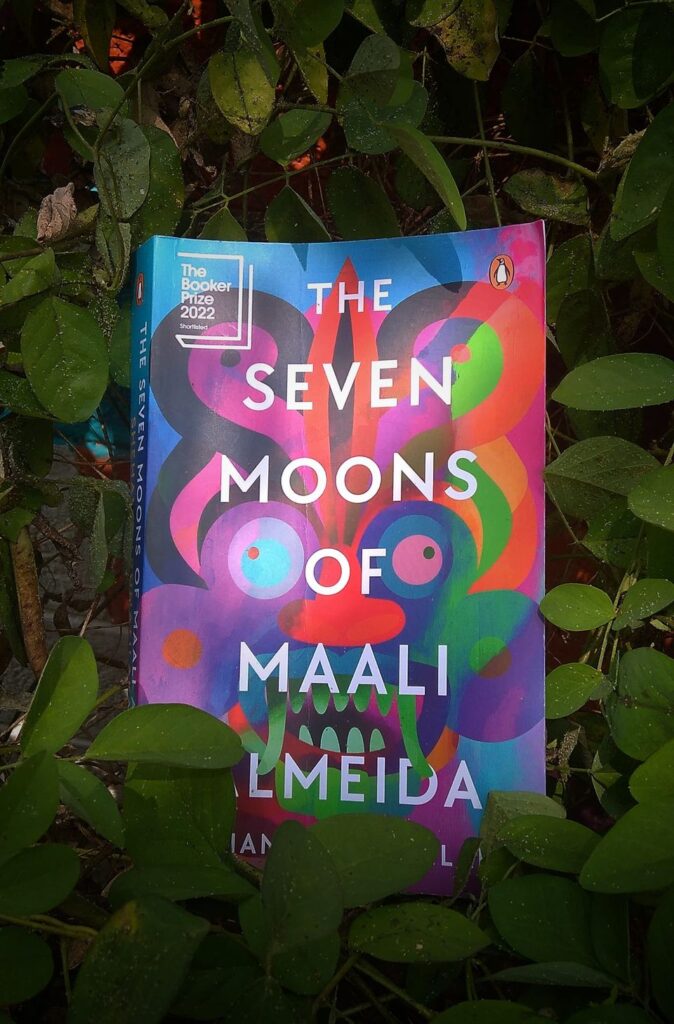
The Seven Moons of Maali Almeida
Shehan Karunatilaka (SK) brings a Kurt Vonnegut for a Show and Tell to the Booker’s AMA, writes children’s books – well sleeptime books for toddlers with big, colourful pictures and trots up the stage to pick up the Booker with glistening black nail paint. Long story short – ‘The Seven Moons of Maali Almeida’ was going to be anything but conventional.
//1983 was an atrocity. Eight thousand homes, five thousand shops, a hundred and fifty thousand homeless, no official body count. The Sri Lankan Government has neither acknowledged nor apologized for it. Your photos will help change that. Tell me, Kolla. Which side are you on?’//
Which side are we on? And what do we do with the inheritance of war? What do we do with a genocide on our hands – when we know some of us looked away and did nothing to stop it; when some of us can frequent the roulette every Friday and have the scintillating company of high-rise Colombo with a dry martini and be oblivious to the terrors unfolding in a Jaffna or an Akkaraipattu?
People are mostly okay with bad things happening to people as long as those people are not them – is the primary core, this book revolves around.
//Bodies of dead JVP-ers are not our problem, Detective,’ says Elsa. If the Sinhalese are killing Sinhalese, why do we care?’
‘I thought you care about innocent people dying,’ says Ranchagoda.
‘We have to look after our people first’
‘That’s a bit racist.’
‘Only when it is the Government policy.’
‘And when LTTE dogs kill TULF rats? Tamils killing Tamils. That’s OK?’
‘At least Muslims don’t kill Muslims’, says Cassim.
The other two stare at him.
‘In Sri Lanka, I mean,’ he clarifies.
‘Give it time,’ says Elsa ‘One day Malays will be killing Moors. And Burghers will be butchering Chetties. Nothing in this country will surprise me.’//
The Seven moons of Maali Almeida, is about Maali Almeida – the protagonist and the ‘you’ in the book (because the book is written in second person), veteran gambler and war photographer, who often talks odds – because the win at the casino and the perfect moment for a photograph, both are governed by the odds of chance, and the odds of not getting killed.
But Maali Almeida, when introduced to us on page 1 – has already been killed and he has seven moons to find out who killed him. And thus begins this unputdownable, whodunit after-life noir, with the opening scene of the after-life, not of fair maidens bathing in shimmering pools and beautiful doves soaring to the skies, but of the grimness of – “a very crowded visa office”, explains SK, in his interviews.
But to us readers, it feels more like a crowded railway station in CST, Mumbai, after four trains have been cancelled – too many people jostling, headless and anxious, fearful and feckless, lost, confused, and helpless against fate, being ushered in only to be jettisoned out. With the very clever second person literary trope, ‘you’ feel you’re there, sitting next to Maali, watching his whole life and afterlife unfold with a surreal believability, and cacophony, between the yakas, mahakalis and pretas – every type of conceivable ghost that can ride the wind.
Anybody – and almost everybody, could have wanted Maali dead, because he is in possession of some very incriminating photographs and negatives that could dispossess some very important names in Srilanka; and Maali’s dangerous and crowded list of employers could be funded by anybody ranging from the LTTE/the Sri Lankan Govt/CIA/JVP/RAW/IPKF – and none of their hands are unsullied from war crimes.
On his sharp and poignant indictment on Sri Lankan history and war, Shehan Karunatilaka infuses into Maali, sharp wit and displaced humour, which makes you want to slap Maali at times – because who hasn’t wanted to slap a man that knows too much and burps witty one liners like he knows it all?
//Dear Andy
To an outsider, the Sri lankan tragedy will appear confusing and irreparable. It needn’t be either. Here are the main players.
LTTE – Liberation Tigers of Tamil Eelam
* Want a separate Tamil State
* Prepared to slaughter tamil civilians and moderates to achieve this
JVP – The Janatha Vimukthi Peramuna
*want to overthrow the capitalist state
*are willing to murder the working class while they liberate them
STF – Special Task Force
*On behalf of the Govt, will abduct and torture anyone suspected of being or abetting the LTTE or the JVP
UN – United Nations
*Have offices in Colombo
*Are arseholes to work with
RAW – Research and Analysis wing
*Indian secret service, here to broker dodgy deals
*Are best avoided
CIA – Central Intelligence Agency
*Sits on the shores of the Diego Garcia islands, holding very powerful binoculars.
*Is this true, Andy? Say it ain’t so. //
Yet, through the 400 pages, as karunatilaka invites you discerningly, into the literary life of Maali, stumbling between odds, reeling from plundered villages and headless corpses, entrenched in the ugliness of humans, dealing with the death of his absentee father, lying to his friends, lying to his mother, lying to his lover, repeating the same story, farce after farce, and façade after façade – you realise that Maali is ‘you’. He is pondering and calibrating your angst, your despair, your helplessness over the fate of your land – the inheritance of your birth, the inheritance of your geography (“what are the odds of being born in a shit hole? Very high.”) – for you.
//Evil is not what you should fear. Creatures with power acting in their interest : that is what should make us shudder. How else to explain the world’s madness? If there’s a heavenly father, he must be like your father : absent, lazy and possibly evil. For atheists there are only moral choices. Accept that we are alone and strive to create heaven on earth. Or accept that no one’s watching and do whatever the hell you like. The latter is by far easier.//
There is race and then there are divisions, and sub-divisions and further divisions. All these divisions are willing to deploy and kill, and all these divisions are funded by people in power, benefitted by these divisions. And when the time comes, a time that is a plunge and a clasp and a feral animal backed into a corner – it appears that everyone is willing to relinquish collateral. In all types of war – civilians must die, and most people – that are not these civilians who died, are okay with it and may even offer to dispose off their bodies.
As Maali walks to his death in the last pages of this 400 page prose, you find yourself saying – “don’t do it, stupid Maail, Just shut up, and stay quiet”, but of course, like all things that cannot be undone, and all mistakes that cannot be taken back, you can do nothing but just feel sorry for this stupid 34 year old person, who just like you- took up one lost cause after another, and cared too much for things that he needn’t have cared about, and stupidly believed – just like you would, that if people knew the truth, if people saw those pictures riddled with blood and suffering and mutilated corpses, people (which people?) would throng the streets and stop this war, this insane war, that destroys whole villages and kills children in swathes.
When the photographs are published posthumously and displayed in an art gallery and barely attracts a crowd, Jaki – Maali’s best friend ruminates, pensively, “Colombo doesn’t seem to care.”
And as a reader, with your head full of Maali, you ponder this desiccated and grimly unanswerable question – was it all nothing? Is life mostly nothing? But Maali, looking down at his last moments of his life, looking down at people that remember him and cry for him, his loves – unfinished, unreturned and open-ended, as he uses his precious moments of after-life to save not his life’s work but the people he cared for – he concludes, that the kindest thing that we can all tell ourselves about life is this –
That, it was not nothing.
The Seven Moons of Maali Almeida
By Shehan Karunatilaka